Thursday, June 7, 2012

Welcome Back (to Capitalism)

I originally penned this post in my notebook just days after returning to the US on the second day of May.  Since then I've continued making observations about my home country with childlike eyes, as if this place was now foreign to me.  My original post is thus embellished with the things I have been experiencing daily for the past month.

- - - - - - - - - - - - - 

My first steps back on American soil after ten months in India were at the Newark airport in New Jersey.  Our plane landed around 4:30 AM.  Waiting in line to go through immigration took a lot longer than did the actual encounter with the immigration officer, which was a fairly quick stamp in the passport.  Welcome back.

This airport wasn't much different than Indira Gandhi International in New Delhi.  Actually, much to my surprise, I think the bathrooms at IGI were cleaner.  Anyway, shortly after we got through immigration I met up with Julie again, a fellow ETA who happened to be on the same flight as me, and we made our way to the baggage claim area, and looked around for trolleys to throw our stuff on.  But imagine this--all of the trolleys are locked up and connected to a machine which you have to feed money in order to release them for use.

I should have been skeptical when I read the sticker "machine accepts $1, $5, $10, and $20 bills" without listing the actual price.  Koi baat nahi, I thought.  No problem.  It must be like some of the supermarkets that charge you a quarter to take a shopping cart, but then return the quarter when you return the cart.

So I pulled my suitcases off the conveyor belt and set them aside while I went to obtain myself a trolley.  There was an employee standing at the closest machine, obviously employed for times of confusion such as these, since the machines must have been intended to be self-servicing.  One Sikh man from my flight was explaining emphatically that he could not get the trolley out.  The woman accompanying the otherwise self-servicing machine somewhat coldly told him, and then the rest of us waiting in line, that we'd have to try a different machine.  The Sikh man continued to explain that the machine took his $5 but he still didn't have a trolley.

Then the four or five of us that had gathered around the self-service machine marched down to another one.  The Sikh man finally got his trolley.  Success!  As I was waiting patiently (though not un-irritated) in a linear fashion for my union with a much sought after trolley, one Indian man ever so casually came and stood in front of me.  Oh no you didn't, I said to myself.  Then I put on my polite voice and said simply, Excuse me, I was waiting here, and he quickly apologized and retreated to the back of the somewhat line that had formed.  I had dealt with enough crowds and pushing and shoving for the past ten months.  I was in America now!  When in the United States...

Now, don't ask me why, after all this hassle, I gave a $5 bill to a machine that also accepts $1 bills, of which I had plenty.  I guess I was still of the (false) belief that I would get my money back when I returned the trolley.  If I could have done without a trolley, I certainly would have.  But there was no way I could manage three suitcases.  So, I paid the $5, loaded it with my suitcases and reunited with Julie.  Smartly, she had traveled with backpacks and one suitcase on wheels and thus was able to bypass the trolley.

We walked no more than five minutes to where we had to re-check our luggage onto our next flights.  We did that, then I gave my trolley to the man (in uniform) who was standing there with a bunch of them, and waited briefly, expectantly, for a refund.  When none was offered, I began to walk away, dumbfounded.

"Ma'am, don't forget your bang," said the trolley man.  Clearly I was too tired for just about anything right now, but I knew I would explore this trolley rip-off issue once I was well-rested and cognizant.

I recounted the incident and my irritation to Julie, who replied dully, "Welcome back to capitalism."  I wonder what happened to those who gave the trolley machine a $20 bill.  They were out $20 for using a trolley for 5 minutes???  That's more than 1,000 rupees!

At the airport I splurged on an everything bagel with cream cheese and a cup of hot chocolate from Dunkin Donuts.  Maybe not the best choice since by now I was already having severe diarrhea and dizzy spells; I'm convinced it was from something I ate on the plane, or maybe the paneer pakora we shared with my in-laws and nephew before boarding.  My core was also sore beyond belief; something I'd never experienced while flying long distances before.

After about a three-hour layover I, along with fifteen other passengers, boarded a puddle-jumper back to Harrisburg.  Thank goodness Gautam packed my woolen shawl in my carry-on suitcase.  The short walk from the gate door to the plane felt like the Arctic!

I fell soundly asleep, all curled up in my woolen shawl from Mussoorie -- where 10 of us had begun to study Hindi 9 months ago -- and woke up above Harrisburg.  I saw ginormous houses (my eyes had become accustomed to Indian-size homes) and a sign for 84 Lumber.  I was almost home.

Among the things that immediately struck me upon returning to the US:

- The lack of Hindi; there is so much English!  I was a little overwhelmed by hearing so many conversations I could understand with ease.

- The lack of Devanagari on signs; most of the airport signs are bilingual, in English and Spanish.   And there's a lot more Spanish than I remember.

- We don't have a caste system in the US, but we do have major equality issues.  Race is a big, persistent one.

- There are so many CARS!  (As opposed to motorcycles.)  And cars in good condition!

- The relative absence of motorcycles and mosquitoes.  Oh, and DUST.

- Vehicles are parked straight, parallel to the lines.

- The absence of honking when the driver in front pauses, briefly, to decide which way to go in... a PARKING LOT!

- Lane driving!

I was met at the baggage claim area by my choti bahin who now seemed taller than me and is sporting a ring on her left hand.  Outside Mom waited with the car.  Both of them looked just about the same as when I'd left.  And my sister being taller than me was later disproved :)

I spent the rest of that day, and part of the next, being sicker than a dog with a disabling fever and the runs, of which I'm now going on my third straight day (remember, I wrote this post long before I'm not posting it!).  It would happen that I lived in India of all places for 10 months with virtually no illness.  Yet returning to the first world knocks me out like a bowling ball.

But, I'm getting better.  The diarrhea's hangin' around but the fever's gone.  And there are a lot of people in this world, and some who are very close to me, who are going through much worse than this as I write.  Despite it all, it feels pretty darn good to be on American soil again.

Of course, it will be much better when Mr. Ashley, as Nick calls him, can join us here as well.  Hopefully that will be much sooner rather than later.

- - - - - - - - - - - - -  

More posts (or a new blog?) to come about things about being home that have since delighted or disappointed me.  Among the delighted: our mailbox, the ease with which a person can send and receive paper mail; green green grass; bright blue skies; white white whispy clouds; starry skies; fresh, clean air.  Among the disappointed: processed food; lack of sabzi-walas (vegetable sellers); vegetables on steroids from the grocery store.

Friday, April 27, 2012

Demystifying the Diplomatic Pouch

Also called the diplomatic bag, apparently the diplomatic pouch really does exist!

I remember there being lots of confusion about the diplomatic pouch prior to departing for India.  We were told that we could send our teaching/reading materials to India ahead of time via this pouch so that we could avoid having the extra weight in our suitcases.

While I wasn't able to solve the mystery in time to use the pouch myself, this mysterious thing really piqued my curiosity as we consider our options for how to get my husband back to the United States (just kidding!).  Seriously though, you will find some creative (and illegal, mind you) uses of the pouch in the links below.

I haven't had the chance to look into this too much yet, but here are a few websites that might help you begin to understand what the diplomatic pouch is (it can be virtually anything) and how to use it.  Please share if you have any success (or unsuccess) with it!

http://en.wikipedia.org/wiki/Diplomatic_bag

http://www.state.gov/m/a/dir/regs/fam/14fam/700/index.htm

http://www.straightdope.com/columns/read/2234/is-there-such-a-thing-as-a-diplomatic-pouch


What's in Your Field?


We have peacocks in ours!

Wednesday, April 4, 2012

We're Not in Delhi Anymore

My Fulbright grant officially ended yesterday.

It literally seems like I was just in my college dorm room, sitting at my desk, trying to figure out who my fellow ETAs would be during these nine months.  I knew this year would pass by quickly, but I guess I didn’t realize kitna quickly, how much quickly.   Now all of my Fulbright bhai-bahin are starting to fly home.  Or to Korea.  A few are hanging around for a while longer, to dance in a final kathak performance.  Or to travel the subcontinent.

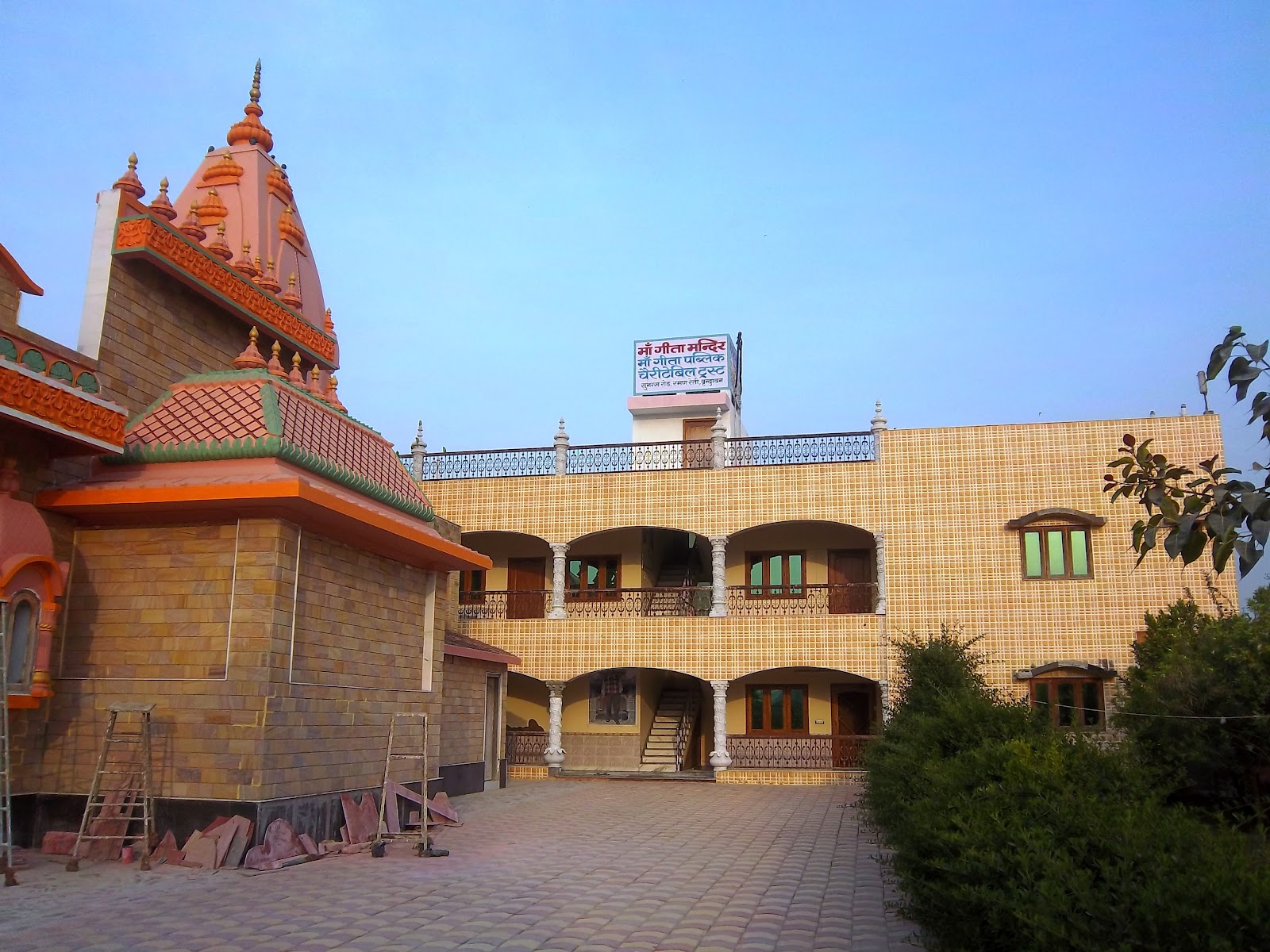
Straight ahead is the guest house, temple on the left.
I presently find myself in the holy Hindu city of Mathura, the birthplace of the blue-skinned, flute-playing, peacock-feather-wearing deity, Lord Krishna.  My husband has recently taken a teaching position at a university here.  And get this, he’s teaching Spoken English of all things!  Actually we are staying in Vrindavan, Mathura’s next door neighbor, and the city where Lord Krishna actually spent his childhood.  But don’t get the wrong impression when I say “city,” we are actually staying in a relatively rural part of the city.

Make that very rural.

In our previous visits to my sasooral (literally: my father-in-law’s house), it always left me befuddled when my husband would tell me in the morning, “I am going to the field,” and then not return for another hour.  Or I would wake up to find that he was not there and, upon his return, I would ask frantically of his whereabouts.  He would then inform me, casually, “Oh, I was in field,” as if this should have been obvious.
I didn’t completely understand then what all went down in the field, but I sure do now.

Early each morning while I make our two cups of ginger-cardamom chai, I can look out the window above our gas stove and see the local villagers, usually men, pooping in the field behind our guest house.  When I open the front door and look over the balcony, in the brush field to my left there are people pooping too.  There are usually smaller children in this field, but all poop the same way.  First, carry either a plastic bottle or tin can of water to the field.  Then, find a good place to squat (one that’s free from briars and other poop, I imagine).  Next, drop your drawers (if you’re a man) or raise your sari (if you’re the occasional woman), squat, and do your business.  When the business is finished, use the right hand to poor the water into the left hand, which does the wiping.  Rinse left hand with water, raise your drawers (or drop your sari), and walk nonchalantly back in the direction from which you came.

In all seriousness, it is so peaceful here.   It's much quieter than Delhi, which is nice for the absence of honking, but that also makes it more difficult to get our daily needs, like milk and vegetables.   And our refrigerator is no longer with us, so they really are needs that have to be acquired daily.  Fortunately it is not too far out of the way to stop at the vegetable market on the way to guest house from the university, and we have a milkman who brings us fresh milk from the local village each evening.

A better shot of the temple under construction.  Almost seems like something from Candyland, hai na?
I’m pretty sure we are currently the only ones staying in this guest house next to Ma Gita Mandir, aside from Ma Gita Ji herself, and the occasional Indian family visiting this hallowed ground.  Mata Ji, as she said I could call her, is a pleasant woman whom I suppose to be in her early-to-mid thirties.  She designed the temple, Ma Gita Mandir, that is being built in front of the guest house rooms.  Construction on the temple started seven years ago, and it should be completed two months from now.  It is an impressive work of beautifully molded concrete, and carved marble and stone.

Wild parrots on the temple ledge!
My favorite part of this temple, though, has to be the colours.  Later in the morning (after the pooping people have vacated the fields), lustrous green parrots, two to nine at a time, fancy to perch on one of the temple ledges that we can see from our balcony.  There vibrant green feathers are the most beautiful contrast against the salmon and tangerine temple.  If I was a skeptic of color therapy before, India has definitely made me a believer.

The view from our balcony, with parrots!
(And I do realize I spelled “color” two different ways in the previous paragraph.  I thought that the first one merited the British “u.”  It kind of grows on you after you’ve been here for a while.)

In the mornings, instead of roosters, we wake to the sounds of peacocks.  On our last visit to thevillage, with some of the ETAs, we came to the consensus that a peacock sounds like a human trying to imitate the sound of a cat’s meow.  Indeed, it does.  But trust me when I say that it’s a much more peaceful alarm clock than it may seem.  By the way, have you ever seen a peacock sitting in a tree?  It is one of the most awkward things I have ever seen.  They are beautiful, yes they are.  But it is a mystery to me how those turkey-size birds can sit so gracefully on a twig-like branch.  Talented fellas, they are.

One afternoon I was studying in our room and heard a kind of swishing sound through the window screen behind me.  I got up and looked down from our second floor window to find two horses wading through the little river running behind our guest house.  I guess they thought the greens looked greener on the other side.  Sure enough, the horses come every day around the same time, like clockwork.

Lots of things run like clockwork here.

If you’re awake before 7 AM you can likely find people squatting in the fields.  At the same time you can hear the peacocks mewing from the trees, as well as the morning readings from the loudspeaker of a nearby temple.  A little later in the morning, the chubby green parrots will land and hop on the salmon and tangerine ledge of the mandir.  Between 11 and 11:30 AM, the horses will come to cross the river for grazing, and the white heron-type birds will look on from their perch on the brick wall above the river bank.  Between three and four in the afternoon a few stragglers may come to the field to complete late “business” transactions.  At this time of year the afternoons in north India tend to be rather quiet as it’s too hot to do anything besides rest.

In the evening, the peacocks will again sing while we wait for the milkman.

Eventually everything quiets down, the stars come out, and sleep arrives.

Then the sun rises, and another day in India begins.


Sunday, March 25, 2012

Our Colourful Home

Nearly three months after settling into our Delhi apartment, I took some "snaps" to share with the rest of you, and eight months later, I'm finally posting them; for safety reasons I thought it wiser to wait till we moved.  Welcome to our home!


Looking straight back the hallway through the front door.
This first room is our dining/study area.  Second on the left is the kitchen, followed by a bathroom-cum-laundry room, spare bedroom, and the master bedroom at the end of the hall.


 Our dining/study room and table.
 It's hard to tell in these pictures, but the walls are pale yellow.


One of my aesthetical favourites about our apartment is the ceilings.
Here, the yellow dining/study room ceiling on the right,
and the pink hallway ceiling on the left.


Our kitchen!  Actually, this was one of the things that sold me on this apartment.  I knew we'd be spending a lot of time in here, so when I saw this kitchen - spacious, with lots of countertop space - it was love at first sight.  Clockwise from the bottom left:  green-handled broom; dustbin (trash can) and dustpan; drying rack; water purifier; gas stove; cooking oil, an essential in every Indian dish; fridge; Domino's and Pizza Hut flyers on the fridge.  And hidden in the top right corner, in the window above the stove, is an exhaust fan.  Which helps to remove some of the hot air, but doesn't do a whole lot for keeping the cooks cool while cooking.  Because everyone uses gas stoves, as a safety measure, there are no overhead fans in the kitchen.  Which explains how the kitchen comes to be 90+ F in the summers.


Bathroom-cum-laundry room.  That's our colourful washer and rinser on the left :)


Master bedroom, complete with makeshift curtain. Temperature-wise, the coolest room in the house.


Master bathroom.  Aka "wet bathroom," very common in India.  Above the toilet is a geyser (pronounced "geezer" by Indians), since homes don't come with a centralized water heater.


The picture on the right is our shower.  There is no ledge to stop the water from running out (hence the name "wet bathroom", but the floor is slightly angled so that the water runs into the drain.


Our choti-choti (very small) back deck and clothesline.
(And don't miss those trees in the background!)

Monday, March 19, 2012

ETAs Visit the Village

We departed at 5:30 Saturday morning for one very bumpy car ride to the village.

Stephanie and Aileen
Nick
Stephanie battled the bumps and tried to sleep.  
Enjoying lunch, Indian style!

 Everyone was keen to sleep on the roof--not something we get to do every day in the US.
The sky was clear and starry, and the mosquitoes didn't hang around for too long.


Good morning, sleepy heads!  We all were pretty exhausted.

Joanna

Kim
Stephanie in the background, Kim, Aileen, Joanna, Abby in the foreground, and Amma (paternal grandmother) in the blue sari
My mother-in-law used cement to mount these broken glass bottles on top of the brick wall surrounding the rooftop to keep away the pigeons and monkeys.  This shot is taken on the roof looking out from the backside of the house.
Another shot of early morning India from the rooftop.

On Sunday, Amma Ji invited us over to her house.  There we enjoyed more sweets and aloo/pyaaj pakora (fried potato and onion).  And got "bindied" by Amma, who seems to be a popular favorite!
 
Kim gets bindied!

So does Jo...
And Stephanie...
Aleen bindies Amma...
...and then gets bindied herself.


Jo's beautiful mehendi/masquerade

Kim gets silly with some of the village boys who stopped by.

Amma wanted us to go on the roof to see all the cow patties she's made so that we have something to remember her by when we go back to the US.  These are special cow patties.  Most are only half this size.  If you look closely, you can see a finger mark pattern in the patties.  These will be burned for fuel.

Now Jo can officially say that she's touched a cow patty!

These four are still in the process of drying.


...more pictures to come soon!


Thursday, February 9, 2012

Five Thousand Views!

Soon after I got my acceptance letter from the Fulbright foundation in India last year, I began perusing past participants' blogs to learn as much as I could about what to expect during the following year.

Of course, anyone who has been to India before knows that the only thing you can really expect in India is the unexpected.

Still, when it came time to create my own blog, I admit that I endeavored to make it a real hit, especially with prospective Fulbright grantees.  Specifically I hoped that it might answer some of the questions that I had around this time last year.

Initially I had the idealistic intentions of blogging regularly about my experiences inside and outside the school walls.

Then India happened.

And the frequency of my posts declined dramatically, much to the dismay of my family back home.

Yet, despite my irregular and sometimes unfinished posts, this blog has managed to receive over five thousand views (whether purposely or accidentally) since July of last year.  During this time I have been delighted to hear from several readers, future travelers or expats to India, and prospective Fulbright applicants.

Now it is less than two months till the completion of my Fulbright grant.  Nowadays in addition to teaching, I am also taking Hindi classes and studying for my Social Studies teaching exam.  Add the regular housework, dishes, and laundry on top of that (we decided not to hire a maid), and you will have some idea as to the cause of my virtual disappearance from the virtual world.

So, thanks for reading, and do keep checking back.  I shall continue developing this blog as time (and India) allows.

All the best,
-ashley

Thursday, December 29, 2011

Transformations

Aside from the internal transformations we are constantly undergoing here in India, it seems we've sustained some external transformations as well.  As one Fulbright researcher we met in Mussoorie predicted, it does appear that we've become a little less "healthy" - and a bit more modest.

Fulbright Pre-Departure Orientation in Washington, D.C.
June 2011

 Fulbright South & Central Asia ETA Conference in Colombo, Sri Lanka
12-17 December 2011

...and I would be wearing the same shirt and scarf in both.

Wednesday, November 23, 2011

Battling Bureaucracy (this time, in school)

According to the Myers-Briggs Type Indicator, my personality type is shared by approximately 1% of the population, making it one of the rarest types.  Myers-Briggs (also called the Jung Typology Test) identifies 16 personality types in total.  I and others like me tend to "regard problems as opportunities to design and implement creative solutions" and are "driven to resolve differences in a cooperative and creative manner."  Perhaps it is these qualities which are manifesting themselves right now in the school where I have been placed.

Since I am the first ETA to be placed in this particular school, I envision myself as pioneering the way for future ETAs.  But even more than this, I really want to do what I was chosen to do--to "assist in teaching conversational English and some composition to middle and high school students."  After all, this was why I wanted to participate in this specific program in the first place.

However, it turns out that, prior to arriving in our schools, our roles may not have been clearly communicated--either to the schools, or to us ETAs, or to both.

One point does seem to have been communicated clearly (at least in my school):  ETAs are to be paired with a regular classroom teacher.  However, the interpretation of this point is where confusion arises.  What does it mean to be "paired with a teacher"?  It seems to me that one thing was especially not understood clearly, and that is the difference between teaching assistant, and teacher's assistant.

Also included in this confusion is whether or not ETAs are supposed to be teaching curriculum.  We ETAs were explicitly told at the beginning of the program that our purpose is to teach spoken English.  But we were recently told by someone else that our schools were told that we should be teaching curriculum, since the students last year didn't take non-curriculum classes seriously enough.  (Ironically, I have found the exact opposite to be true.)  It is obvious that something has been miscommunicated.  It's just not clear what.


It is a sad fact that most students can make it through a full 12 years of government school without ever creating a sentence of their own in English.  All of the ETAs have noticed that their respective government schools rely heavily on memorization as opposed to actual learning.  So the whole purpose of offering spoken English classes is to give students exposure to the English language as it sounds in everyday conversation, as well as to allow them to try their hand at creating meaning in the language for themselves.  And for many of them, this would be the first opportunity they would have to do so.

Till now I have been working with three different English teachers--one each from Class (Grade) 6, 7, and 8.  In the beginning I was having the opposite problem as the other ETAs, many of whom had been given their own classes, in that I was hardly getting any teaching time.  And the time I was given was given only at the last minute:  Ashley, you would like to take some activity?  Well, no, not really.  Not when there are only five minutes remaining and the students' brains have already checked out.

So I proposed the idea of taking separate classes for Spoken English.  I began with a trial run of two small groups from Class 8.  One group of girls, and one group of boys.  We met once a week for about one month before I recently proposed doing this on a much larger scale.  I had seen huge strides in both small groups from Class 8.  The kids were interested, excited about our class, and the girls especially started participating more during the regular class periods.  So I proposed--politely, albeit with conviction--to my three cooperating teachers that I discontinue my regularly assigned curriculum classes and take small groups of approximately 10 students each for Spoken English during the students' free periods instead.

Now.  Such radical ideas as this one are not easily received or accepted in a country and/or school system which function largely on a system of hierarchy and bureaucracy.  Especially when the one proposing such a radical change is just a foreign peon like me.

Still, I took the pains of drafting a schedule that would make the implementation of my radicalism possible.  Two of my three teachers agreed to release me from their curriculum classes so that I could be available for Spoken English.  The third teacher is the wife of a government official of Delhi, so no one dared challenge her refusal to release me from her evil grip.  (She's really a lovely lady, but this just drives me up a wall.)  When I took it upon myself to appeal my position to her, she politely informed me that, as she was currently tied up with teaching Class 10 and other activities, she could not let me go on account of those occasions when she would be unable to make it to class.  In other words, she wanted to keep me as her own personal on-call substitute (aka arrangement).

She neglected to mention her fondness of having me write questions and answers on the board after the completion of each chapter, which the students then copy directly into their appropriately named copies (notebooks).  Which, I need not mention, involves absolutely zero interaction or spoken English whatsoever.

Anyway, now I'm just barfing up my frustrations.  But this is a large part of my wanting to take Spoken English classes on my own.  Not to mention that it would be completely feasible:  Since my school is currently without a librarian, all Library periods are free.  And since the Work Experience teacher also works in the school office, he is too busy to actually teach WEx, so those are free periods too.

So I completed  draft schedule, which still included all of my regularly scheduled classes with the third teacher.  After all, you have to pick and choose your battles, especially when the battlefield is in a foreign country.  I showed the schedule to my coordinating teacher who, though not without some hesitation, agreed to approach the principal with with me.  Surprisingly, despite her initial refusal to make any changes to the time table, the principal had little problem approving my proposed schedule the second time around.  Maybe it was because I had given her some candies and a small American flag in celebration of International Education Week earlier that day.  Nevertheless, it was a victory!

But that was on Friday.

On Monday I tried to present a copy of the newly approved schedule to my coordinating teacher, who now refused to accept it, and will not accept it until I check with the computer teacher that my proposed (and recently approved) schedule does not clash with the periods assigned to the training teachers (student teachers) who are in our schools till December.

When computer ma'am requested my new schedule from my coordinating teacher, she refused to give it to her--three times!  Of course she did.  How could she give a copy of the schedule when she would not accept it from me?!  This is one of the many examples of bureaucracy and hierarchy in India.  When I relayed the situation to computer ma'am, I suggested that I could just give the schedule to her directly.  But, remaining true to the tradition of jumping through unnecessary hoops, she said she would try to get it from my coordinating teacher first.  By the end of the day she took the schedule straight from me anyway.

Well, folks, here's how this part of the story ends.  For now I shall continue going to all of my regularly scheduled classes, sitting quietly or writing on the board as I am required to do so.  But, as long as students keep coming to me and asking for Spoken English classes, you can bet I'm not going to turn them away.  If you build a good rapport with students, those who genuinely want to learn English will come--despite what any official schedule or institution says.  After all, aren't these the students we aim to be teaching in the first place?

Some may say that I am wasting my time and energy in this battle against the system.  And maybe there is some truth to this.  But one thing is for certain:  I'm not giving up easily.

Thursday, November 10, 2011

Reminders of Home

It's random things, like these bumper stickers, that remind me of home.


Sunday, October 9, 2011

To Hire a Maid, or Not to Hire a Maid

"The first thing I noticed about Bombay, on that first day, was the smell of the different air.  ...  I know now that it's the sweet, sweating smell of hope, which is the opposite of hate; and it's the sour, stifled smell of greed, which is the opposite of love.  It's the smell of gods, demons, empires, and civilisations in resurrection and decay.  It's the blue skin-smell of the sea ... and the blood-metal smell of machines.  It smells of the stir and sleep and waste of sixty million animals, more than half of them humans and rats.  It smells of heartbreak, and the struggle to live, and of the crucal failures and loves that produce our courage.  It smells of ten thousand restaurants, five thousand temples, shrines, churches, and mosques, and of a hundred bazaars devoted exclusively to perfumes, spices, incense, and freshly cut flowers.  Karla once called it the worst good smell in the world, and she was right...."  --from Shantaram, by Gregory David Roberts (2003)

My first taste of India as a Fulbright scholar, after that initial oppressive curtain of heat and all those distinct smells, was the five-star Taj Mahal Hotel, complete with more attendants and assistants than a queen should require in her entire royal life.

There was one to open the door of your vehicle, one to put your bags through the security scanner, another one to hand them back to you.  Inside, one to open the entrance door.  And another for the second.  One to press the "up" button on the elevator.  One to bring your luggage to your room.  One to make your bed in the morning, to put a dust cover on in the afternoon, to take it off again and turn down the sheets at night.

One of the bahut sundar (very beautiful) flower arrangements at the Taj Mahal Hotel, New Delhi.
The place was magnificent, the enormous flower arrangements, the marble floors and fountains overwhelmingly grand.  We were welcomed with leis of fresh flowers and freshly-squeezed watermelon juice.  The scent of Jasmine permeated the crisp air.

It was a foil to the India waiting outside.  And while some might very well relish the excellent service, for me it was all a little overwhelming.  From our hotel room we had a bird's eye view of the meticulously kept garden and pool below - they were also buzzing with attendants sweeping the paths and trimming the shrubbery, cleaning the pool and folding beach towels.  Daily.  All day long.

The view from Joanna's and my hotel room.
 And so began an inner conflict that would continue to build force throughout my stay in India.  On the one hand, hiring so many workers seems superfluous and oftentimes menial.  After all, do guests really require someone to press the elevator button for them?  On the other hand, all of these workers are employed, working in a beautiful, air-conditioned facility, and are supporting their families.  I understand both sides of this contradiction, but how can I make peace with them?

It wasn't until this trip to India that I realized how much I pride myself on being a self-sufficient American, capable of everything from laundry to cleaning to cooking, for myself. But here in India, in my own apartment, I have seriously considered hiring a maid.  Actually, we have already hired one lady to clean our small front porch and the stairs leading up to our third floor apartment, as per our landlord's requirement to keep them clean.  And even that decision, while not quite as difficult, was one that came with some hesitation.

But our house is our home, and having someone come inside to take care of what, in my opinion, we should be able to do, is a back-and-forth battle I often have in my mind, and sometimes with my husband. As Stephanie put it, "Cleaning in India is different.  It's a different kind of cleaning."  By which she means, and is correct, that if you want to be able to walk barefoot in your own house,  you must clean every day without fail.

There are other things that I had not taken into consideration when I long ago decided that I would never have a bigger house than I could take care of by myself.  (Of course, I never imagined that a two-bedroom apartment would be too much to take care of, either.)  There were some unmentioned assumptions in there that I can no longer take for granted.  Things like a washing machine.  A gallon of milk that would last for an entire week in the fridge.  Fruits and vegetables that would do the same.

But that is very different than the life I am currently living.  Currently we buy milk at least every other day because keeping it any longer would cause it to spoil.  Other things that take time and energy:  having to boil milk before consuming it.  Making yogurt every day (which I thoroughly enjoy, but which still takes time).  Filling the water tank between 5 and 7 each morning, or 4-6 each night (this is done merely by flipping the switch for the water pump, but then we have to look up o our roof to make sure it's not overflowing since our landlord has, for some reason, not fixed the water level meter, which prevents the tank from overfilling and overflowing into the street in front of someone else's house).

Then there is the cleaning, which I typically enjoy doing.  The problem is not so much the cleaning as the frequency and kind of cleaning.  Delhi is really dusty.  And marble floors don't disguise dirt and dust and hair nearly as well as carpet. 

We have designated Saturdays to be our cleaning days, which consist mainly of cleaning our marble floors - another thing I had to learn.  (We do this by sprinkling a teensy-weensy bit of soap powder all over the floor and flooding it with water, then using a squeegee to chase out the first round of water and most of the dirt, then flooding it again and squeegeeing more meticulously to get the remainder of the dirt.)

In and of itself it's really not that bad, but once again arises the issue of time.  We've got the cleaning of all of the floors and both bathrooms down to about 2 hours.

All of these things are compounded by the heat.  Oh, and everything has to be cooked on the stove because we, and most middle-class Indians, do not have an oven.  So cooking each evening takes approximately 2 hours.  And there's no microwave to reheat leftovers for lunch the next day - that has to be done on the stove as well.

I usually wait till Saturday or Sunday to wash clothes, by hand.  By the time all the housework is finished there is virtually no time to relax.  Hard to believe the rest of the teachers work six days a week.  (Thank you, America, for keeping it to five!)  But seriously, there is hardly time to read for pleasure, to run or exercise, to blog, or go exploring.  Even our infrequent "vacations" sometimes seem like work.  Simply, even living simply in India requires a lot of energy.

The days of utter exhaustion are the ones that cause me to fall victim to that ongoing conflict of whether or not to hire a maid.  All of the teachers at school have one, and they've even told me to tell my husband that I need one.  But I still don't know if I actually want one.  Then again, I would also be helping someone - a wife, mother, or grandmother - earn an income for her family.  I would be supporting the local economy.  Or would I be exploiting them by paying what little wages they require?  I could offer to pay them more, but neither does this come without problems.  Paying someone above the expected amount can cause disequilibrium for the others, so to pay more could actually worsen the system.

Oh, India.  Your endless supply of contradictions astounds me.
In short, I still haven't reached a conclusion.  And I won't be surprised if this back-and-forth battle continues till the end of my grant period.  I was relieved to find out that three of the ETAs in Kolkata have also chosen not to hire a maid.  All the other ETAs have one.  But they are experiencing similar ambivalent feelings.  Julie reminded me that our language classes and English Language Training classes, also consume a significant portion of our time - up to 4-6 hours per week, in addition to 6.5 hour school days.  Oy vey!

Oh look, time to make lunch!
 

Thursday, September 15, 2011

"The Namesake" by Jhumpa Lahiri

Just finished reading this novel, packed with tons of American and Indian cultural references with which I can identify.  I highly recommend this to anyone curious about India, but especially those familiar with both India and the U.S.  Looking forward to the seeing the movie, but prepared for it to be a disappointment after reading the book, as usual.

FRRO Made Easier

Our group was fortunate to not encounter too much red tape at the FRRO.  And when I went back the second time, to update my place of residence after settling on an apartment, I was in and out in less than one hour.

But it gets even better.  Beginning from the first week of August 2011 onward, registration and visa extension forms will only be accepted online for the Delhi FRRO Office, which should make the process less stressful yet.  (However, you may still have to physically go to the office if your residential address changes - not sure about that one.)

For more information, see the Indian Bureau of Immigration's website.

Thursday, September 8, 2011

HEADLINE: Panic as midnight tremor rattles Delhi


I survived my first (and hopefully only) earthquake!  A 4.2 on the Richter scale.  My husband had just returned home from Aligarh and we sat down to eat around 11:30 PM last night.  We felt a little rumbling, and heard what sounded like a nearby train, and I grabbed my husband's hand as I had no idea what was going on.

Outside, people were fleeing there houses as if they were participating in a school fire drill.  We, perhaps unwisely, stood on our front porch and watched from the third floor.  Fortunately for us, it only lasted some seconds.  Perhaps next time though, we should consider exiting our apartment, just to be safe.

To give you some idea of the personalities I work with at school...  Some of the teachers, one old enough to be my grandmother, reasoned that my husband was the cause of the earth's tremors: "Your husband is home now?  Oh!  That's why there was an earthquake around midnight!"

HEADLINE: 11 killed as blast rocks Delhi High Court complex


A sad situation in India, to be sure.  And an unpleasant reminder that, ten years after the horrific events of September 11th, the human race still has much to improve upon.

Fortunately, despite living less than twenty minutes from the site of the blast, we haven't really noticed any changes in daily life, save for the enhanced security in the metro.